
For food, beverage, and condiment manufacturers that reuse glass bottles, processing returned bottles takes more than a simple rinse. Paper labels, adhesives, and residue inside the bottles often make cleaning more difficult. As a result, many customers focus on a practical question when selecting a glass jar washing machine: Can the equipment effectively remove labels during the cleaning process?
The answer depends on the label material, adhesive type, how long the label has been attached, and the washing temperature, spray pressure, and processing time of the glass jar washing machine. A well-designed glass bottle washing system combines label softening, peeling, and subsequent rinsing to provide continuous cleaning for reusable glass bottles.
Why Is Label Removal a Critical Step in Glass Bottle Washing?
Used glass bottles typically contain several types of contaminants, such as beverage residues, sugar, grease, paper debris, and label adhesive. In particular, labels that have been attached for a long time are difficult to remove completely with plain water spraying alone.
Therefore, glass jar washing machines must be designed with cleaning processes tailored to the specific contamination, ensuring that labels are thoroughly softened first before being separated from the bottle surface by water flow and spraying.
Temperature, Time, and Spray Pressure Must Be Properly Balanced
Cleaning effectiveness cannot be achieved simply by increasing spray pressure. Appropriate water temperature helps soften the labels and some of the adhesive, while sufficient processing time allows the water flow to fully act on the edges of the labels. Subsequently, high-pressure spraying can further rinse away the loosened labels and residues.
How Does a Glass Jar Washing Machine Handle Labels?
A well-designed glass jar washing machine process typically combines pre-washing, main washing, and clear water rinsing.
1. Pre-wash to Remove Surface Residues
Once the glass jars enter the glass bottle washer machine, a spray wash first removes beverage residues, dust, and loose labels from the jar surfaces, preparing them for subsequent deep cleaning.
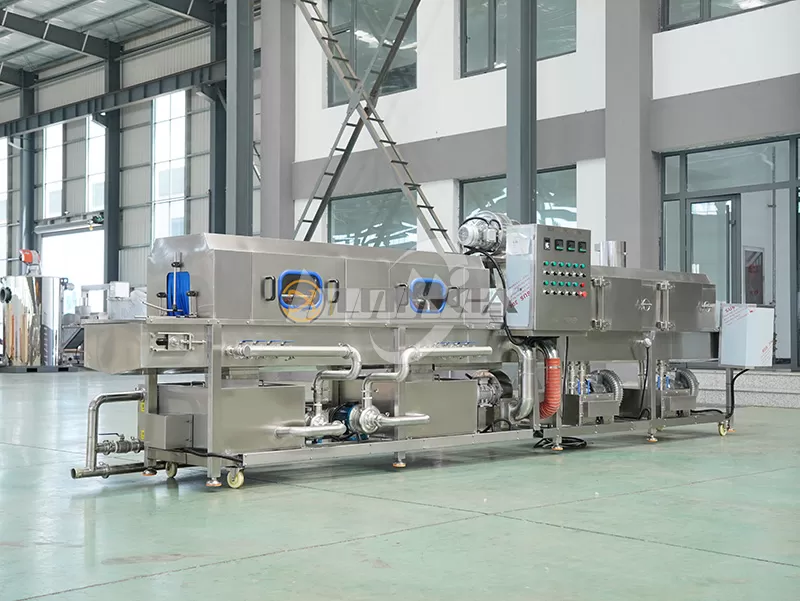
2. Deep Cleaning and Label Removal
After pre-treatment, the water flow further acts on the jar surfaces. The position, number, and spray direction of the nozzles directly affect the cleaning effectiveness in the label area. For containers with uneven surfaces or large label coverage areas, it is especially important to design the spray coverage range appropriately.
3. Clear Water Rinse to Reduce Residues
After the labels are removed, paper debris and adhesive may still adhere to the bottle surface. Therefore, the subsequent clear water rinse cannot be omitted; otherwise, a situation may arise where "the labels are gone, but the bottles are still not clean."
What Should Be Confirmed with the Manufacturer When Purchasing Equipment?
Customers should provide the bottle height, diameter, mouth size, bottle shape, hourly processing capacity, label material, and primary contaminants.
If label removal is the core requirement, it is also recommended to provide actual used bottles or label samples in advance for testing. Different labels and adhesives present varying degrees of difficulty to remove; only by determining cleaning parameters based on actual samples can the spray system, conveyor structure, and cleaning process be configured more accurately.
LONKIA Glass Bottle Washing Machine
LONKIA can configure customized glass bottle cleaning solutions based on the customer's bottle shape, processing capacity, and cleaning requirements. The glass jar washing machine integrates multi-stage spraying, recirculating water filtration, and subsequent rinsing and drying processes to ensure a continuous and stable cleaning operation.
For customers needing to remove labels, adhesives, and residues from the inside and outside of bottles, we recommend clarifying bottle specifications and actual contamination levels before purchasing. Confirming the equipment solution based on sample bottles is more effective for achieving cleaning results that meet production needs than simply selecting equipment based on generic parameters.
Conclusion
Whether a glass jar washing machine can remove labels from reusable glass bottles is not determined by a single factor. Label type, washing temperature, processing time, spray pressure, nozzle layout, and subsequent rinsing all influence the final result.
If your production involves a large volume of recycled glass bottles, you should prioritize confirming whether the equipment can achieve a seamless transition between label removal, washing, rinsing, and subsequent drying—rather than focusing solely on the machine’s hourly throughput. Through testing with actual sample bottles and tailored configurations, you can more accurately determine whether the equipment is suitable for your bottle types and cleaning requirements.
