
In modern poultry farming and processing, the cleaning efficiency of chicken cages directly impacts production efficiency and bird health. Lonkia's chicken crate washers achieve rapid, thorough cleaning through high-pressure spraying, brushing, and multi-stage rinsing. This article provides a detailed analysis of chicken cage washers to assist customers in making informed decisions.
Working Principle of Chicken Crate Washers
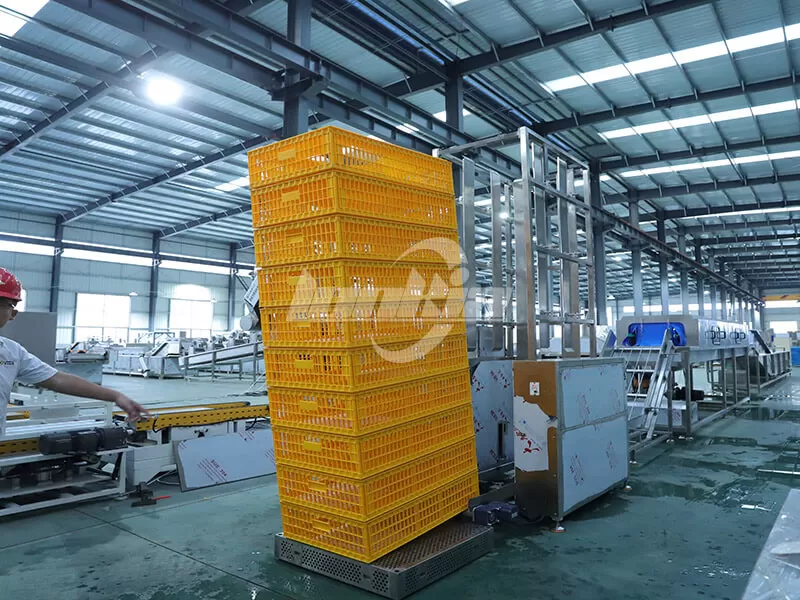
Lonkia chicken cage washers combine mechanical spraying with high-pressure rinsing to ensure thorough removal of dirt, feathers, and residues from both the cage surfaces and internal structures. The equipment typically features hot or cold water systems, with the option to add detergent as needed for enhanced cleaning. During the wash cycle, cages pass through multiple stages of spraying and scrubbing, guaranteeing coverage of every corner and achieving standardized cleanliness levels.
Key Factors Affecting Chicken Crate Washer Capacity
- Conveyor System Speed: The movement speed of cages on the conveyor chain directly determines the number of cages cleaned per unit time. Lonkia's conveyor chain design ensures stable, continuous, and efficient cage delivery into the cleaning zone.
- Spray and Scrubbing Duration: The scientific combination of spray systems and scrubbing modules enables efficient cleaning of each cage within a short timeframe. Adjusting nozzle angles and water pressure optimizes cleaning efficiency.
- Continuous Operation Capacity: The robust stainless steel construction enables prolonged continuous operation without compromising cleaning performance. Production capacity remains stable during extended runs, meeting high-intensity production demands.
- Cage Dimensions and Quantity: Design adaptability for various cage specifications also impacts cleaning speed. Lonkia's poultry washers accommodate multiple cage sizes while maximizing hourly throughput.
Calculating Hourly Cleaning Capacity
Customers can use the following formula for preliminary capacity estimation:
Hourly Chicken Cage Cleaning Volume = (Conveyor Speed × Single-Cycle Cleaning Efficiency) ÷ Cage Interval Time
Actual capacity may vary based on soiling levels, cage specifications, and cleaning water temperature. Lonkia offers customized solutions to optimize capacity parameters in line with production line requirements, ensuring machine efficiency meets expectations.
Practical Recommendations for Boosting Capacity
- Adjust spray water pressure appropriately: Set high or medium pressure based on soiling levels to prevent inadequate cleaning from low pressure.
- Maintain brush cleaning modules: Regularly clean brush bristles to ensure consistent scrubbing performance and prevent capacity loss.
- Optimize conveyor chain spacing: Adjust spacing according to cage dimensions to reduce jams and increase hourly throughput.
- Integrate Pre-soak and Rinse Stages: Combine pre-soak and rinse sections with the main wash stage to create a continuous production flow, boosting overall efficiency.
Conclusion
Understanding the production capacity of chicken crate washers is crucial for customers in model selection and production planning. Lonkia chicken cage washers deliver stable, high-efficiency cleaning capabilities while offering customizable configurations to optimize hourly throughput. Whether for farms or processing plants, selecting the right washer significantly boosts productivity, reduces labor costs, and ensures cage cleanliness and poultry health.
For detailed specifications or customized solutions, contact Lonkia's expert consultants. We provide comprehensive chicken cage washing solutions and quotation information.
