
In the food processing, logistics, and manufacturing industries, pallet cleaning has always been a critical factor affecting production efficiency and product quality. Many companies are torn between manual cleaning and using pallet washing machines. This article will provide practical insights to help customers determine which method is better suited to their production needs.
What Are the Limitations of Manual Cleaning?
Manual cleaning may seem cost-effective, but it presents significant challenges in actual production:
- Inconsistent cleaning results: Manual operations struggle to reach gaps and hard-to-reach areas on pallets, often leaving behind residue.
- Low efficiency: Slow processing speeds make it difficult to meet the demands of continuous production.
- High labor intensity: Reliance on manual labor leads to high management costs.
- Difficulty in standardization: Cleaning results vary significantly depending on the operator.
In high-frequency usage scenarios, these issues directly impact production rhythms and can even pose quality risks.
How the Pallet Washing Machines Work?
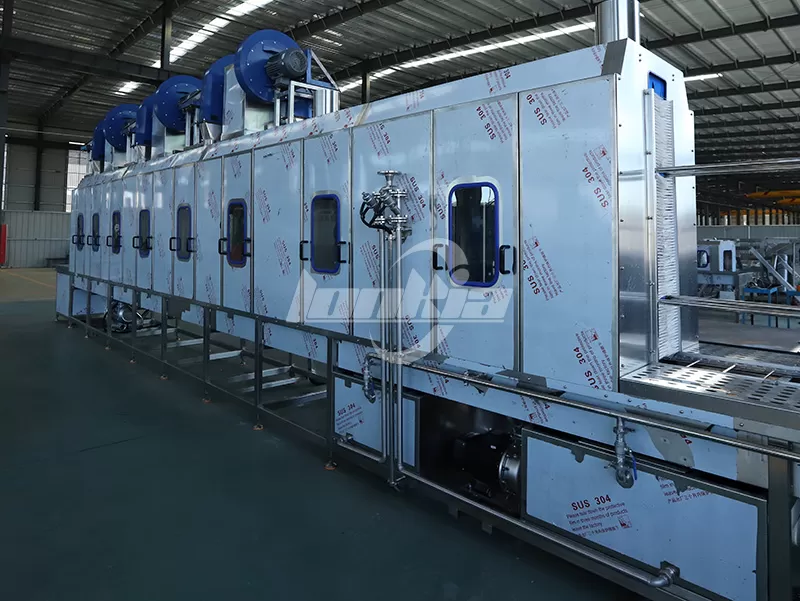
Compared to manual methods, the pallet washing machine achieves consistent cleaning results through an automated process. Its core steps include:
- Pre-rinse: High-pressure spraying removes surface contaminants
- Main wash: Hot water or detergent breaks down grease and oil
- Rinse: Removes residual detergent
- Drying: Rapid water removal, allowing immediate return to service
The entire process is controlled by a PLC system, enabling continuous conveyance and automatic cleaning, significantly reducing manual involvement.
Cleaning Effectiveness Comparison: Which Is More Thorough?
Pallet washing machines use multi-angle spray systems to cover every part of the pallet, including hard-to-clean areas such as crevices and the bottom structure, whereas manual cleaning often leaves spots missed.
At the same time, high-temperature water flow and pressurized jets effectively break down grease and deposits, ensuring a more thorough and consistent clean.
👉 For customers, this means:
- Controllable cleaning standards
- Reduced risk of product contamination
- Trays can be reused immediately
Differences in Efficiency and Production Capacity
Manual cleaning typically relies on labor and has limited efficiency. In contrast, the pallet cleaning equipment enables continuous operation:
- Processes hundreds of trays per hour
- Can be directly integrated with production lines
- No downtime required
Automated conveying and continuous cleaning make it the optimal choice for high-capacity factories.
Long-Term Cost Analysis
Many customers initially focus on the initial equipment investment, but from a long-term perspective:
Manual cleaning:
- Labor costs continue to rise
- High management and training costs
- Low efficiency leads to hidden losses
Pallet washing machine:
- One-time investment, long-term stable operation
- Automation reduces reliance on manual labor
- Improved cleaning efficiency leads to higher output
From a comprehensive cost perspective, automated pallet cleaning equipment offers greater advantages.
How to Choose the Solution That Best Suits Your Needs?
If your production involves the following conditions:
- High pallet usage frequency
- Strict cleaning standards
- Rising labor costs
- Requirement for stable, continuous production
Then, choosing a pallet washing machine is the more reasonable solution.
Pallet washer machines like that provided by Lonkia features a multi-stage washing and automatic control design, allowing cleaning parameters to be adjusted according to actual needs, making it better suited for real-world factory applications.
Conclusion
Manual cleaning is suitable for low-frequency, small-batch scenarios, but in modern production environments, it struggles to meet efficiency and standardization requirements.
In contrast, pallet washing machines offer clear advantages in cleaning effectiveness, efficiency, and stability, making them the choice of an increasing number of companies.
For customers seeking to boost production efficiency and reduce operational pressure, automated washing equipment is not merely an upgrade—it is a necessary investment.
